Swachh Bharat Abhiyan (Grameen) Transforming Karnataka’s Sanitation Landscape
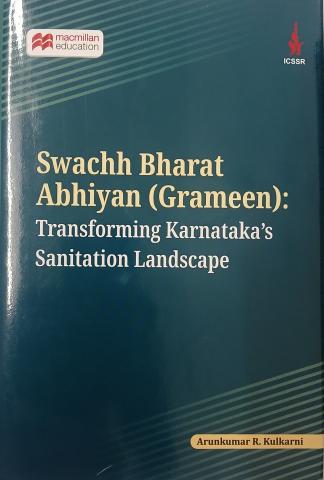
Author : Arunkumar R. Kulkarni, Nayanatara Nayak, Nagraj S. Mugadur, Jyoti S. Pattanshetti, Bharati Y. Khasnis, D. R. Revankar, & Dundappa Y. Badlakkanavar
Co-publisher: Indian Council of Social Science Research (ICSSR), in association with Macmillan Education India Private Limited
Publication Year : 2026
Price : 720
About the Book
This book, Towards Viksit Bharat: Achievements and Challenges of Swachh Bharat Abhiyan-Grameen (SBM-G) in Karnataka, critically examines the implementation and outcomes of SBM-G in rural Karnataka. Launched in 2014, SBM-G has played a pivotal role in transforming rural sanitation through enhanced infrastructure, widespread hygiene awareness, and active community participation. The study, based on primary data, evaluates both the successes, such as a significant reduction in open defecation and ongoing challenges, including behavioral change, solid and liquid waste management, and sustainability concerns. By aligning its analysis with the vision of Viksit Bharat@2047, which emphasizes inclusive and sustainable development, the book underscores sanitation as a foundational pillar of national progress. It offers evidence-based insights and practical recommendations that can guide future sanitation policies and interventions. This research is a valuable resource for policymakers, academics, and development practitioners seeking to deepen their understanding of SBM-G's long-term impact and to contribute meaningfully to the realization of a clean, healthy, and developed India.
About the Authors
Dr. Arunkumar R. Kulkarni is an Assistant Professor at the Centre for Multi-disciplinary Development Research (CMDR), Dharwad, Karnataka. He holds a Ph.D. from Mangalore University and specialises in rural development, agriculture, water supply, sanitation, and common property resource management. He has completed over 25 research projects funded by ICSSR, NABARD, and government agencies, and has published more than 60 research papers in reputed journals. He is a recognised Ph.D. guide at Karnatak University, Dharwad, and actively mentors research scholars.
Prof. Nayanatara Nayak holds a Ph.D. in Economics from Mangalore University and has extensive experience in research on health, environment, decentralisation, and resource management. She is a recognised doctoral guide and has been associated with several national and international research initiatives. A recipient of fellowships from ICSSR, Ratan Tata Trust, and SANDEE, she has also participated in academic programmes at institutions including Johns Hopkins University. She is currently serving as a Professor at CMDR, Dharwad.
Dr. Nagaraj S. Mugadur is an Associate Professor in the Department of Economics at Karnatak University, Dharwad, with over 14 years of teaching and 18 years of research experience. He holds a Ph.D. in Economics and has completed several research projects. He has guided multiple Ph.D. scholars and postgraduate dissertations and has published more than 60 research papers. He is a life member of professional bodies including The Indian Econometric Society and the Indian Social Science Association.
Dr. Jyoti S. Pattanshetti is an Assistant Professor and Research Supervisor at BLDEA's J.S.S. College of Education, Vijayapur. She holds a Doctorate in Education and has qualifications in Physics and Education, along with UGC-NET and K-SET. She has authored books, published numerous research articles, and presented papers at national and international conferences. She actively contributes as a resource person, reviewer, and academic facilitator in professional programmes.
Dr. Bharati Y. Khasnis is Principal at BLDEA's J.S.S. College of Education, Vijayapur, and a Research Supervisor. She holds a Doctorate in Education and postgraduate degrees in Mathematics and Sociology. She has authored several books and published widely in reputed journals. She has presented papers at various conferences and contributes as a resource person and academic mentor in research and training programmes.
Dr. D. R. Revankar is a Research Assistant at CMDR, Dharwad, with over two decades of experience in developmental research. He holds a Ph.D. in Economics with specialisation in health economics. His work spans health financing, education, governance, and rural development. He has contributed to several research projects funded by national and international agencies and is actively involved in training and capacity-building initiatives.
Dr. Dundappa Y. Badlakkanavar is an Assistant Professor at CMDR, Dharwad, with a Ph.D. in Social Work from Karnatak University. He has published extensively and completed research projects on water conservation, education, and rural development. He has authored books, presented papers at national and international conferences, and received several academic awards. His research interests include community development, women's empowerment, and social science research.
| Contents | |
|---|---|
| Preface | |
| Acknowledgements | |
| Chapter 1: Introduction | |
| 1.1 Introduction | |
| 1.2 History of Sanitation in India | |
| 1.2.1 Sanitary Work in British India | |
| 1.3 Sanitation Policies and Programmes in India | |
| 1.3.1 Sanitation During First Five-Year Plan Period | |
| 1.3.2 Central Rural Sanitation Programme (CRSP) | |
| 1.3.3 Total Sanitation Campaign (TSC) | |
| 1.3.4 Nirmal Bharat Abhiyan (NBA) | |
| 1.3.5 Swachh Bharat Mission (SBM) | |
| 1.4 Review of Literature | |
| 1.5 Major Research Questions | |
| 1.6 Specific Objectives of the Study | |
| 1.7 Scope of the Research | |
| Chapter 2: Methodology of the Study | |
| 2.1 Area of the Study | |
| 2.1.1 Brief Profile of Karnataka | |
| 2.1.2 Demographic Profile | |
| 2.1.3 Social Structure | |
| 2.2 Data Sources | |
| 2.3 Sampling Design | |
| 2.4 Reference Period | |
| 2.5 Data Collection, Presentation, and Analysis | |
| 2.6 Nature of Study | |
| 2.7 Pilot Survey | |
| 2.8 Limitation of the Study | |
| Chapter 3: Profile of Selected Households | |
| 3.1 Households by Social Category | |
| 3.2 Households by Type of Ration Card | |
| 3.3 Education Level of Head of the Households | |
| 3.4 Ownership of House | |
| 3.5 Type of House | |
| 3.6 Fuel for Cooking | |
| 3.7 Households having Agricultural Land | |
| 3.8 Households having Livestock | |
| Chapter 4: Swachh Bharat Mission Gramin in Karnataka | |
| 4.1 Progress to Sanitation Before SBM-G | |
| 4.2 SBM-G in Karnataka | |
| Chapter 5: Findings of the Study | |
| 5.1 Effective Implementation | |
| 5.1.1 Access to Toilet | |
| 5.1.2 Toilets Constructed under SBM-G | |
| 5.1.3 Provision of Toilets at Schools and Anganwadis | |
| 5.1.4 Solid and Liquid Waste Management | |
| 5.1.5 Achievement of ODF Status | |
| 5.1.6 Concluding Observations | |
| 5.2 Efficiency of Swachh Bharat Mission-Grameen (SBM-G) | |
| 5.2.1 Rapid Toilet Construction | |
| 5.2.2 Location and Condition of Toilet | |
| 5.2.3 Usage of Toilet | |
| 5.2.4 Child Faeces and Personal Hygiene | |
| 5.2.5 Segregation and Disposal of Waste | |
| 5.2.6 Extent of Incentives to have Toilet | |
| 5.2.7 Regular Monitoring and Evaluation | |
| 5.2.8 Convergence of Resources | |
| 5.2.9 Level of Community Participation | |
| 5.3 Outcome/Impact of the Programme | |
| 5.3.1 Change in the Sanitation Practices | |
| 5.3.2 Ensured Safety, Security and Dignity of Women | |
| 5.3.3 Time Saved by Using Toilet Rather than Open Defecation | |
| 5.3.4 Impact on Schooling of Children | |
| 5.3.5 Impact on Health | |
| 5.3.6 Clean Environment | |
| 5.3.7 Improvement in Living Conditions | |
| 5.3.8 Eradication of Manual Scavenging | |
| 5.4 Sustainability of the Programme | |
| 5.4.1 Availability of Water for Toilet | |
| 5.4.2 Availability of Manpower to Repair Sanitation Infrastructure | |
| 5.4.3 Cleaning of Toilet and Pit | |
| 5.4.4 Practice of Open Defecation | |
| 5.4.5 Knowledge, Attitude and Perception About Sanitation | |
| 5.5 Equity of the Programme | |
| 5.5.1 Social Inclusion | |
| 5.5.2 Economic Inclusion | |
| 5.5.3 Gender Equity | |
| 5.5.4 People with Disabilities | |
| 5.5.5 Women's Participation | |
| 5.5.6 Geographical Equity | |
| 5.5.7 Best Practices and Case Studies | |
| Chapter 6: Recommendations | |
| 6.1 Recommendations for Short-Term (0 to 2 Years) | |
| 6.2 Recommendations for Medium-Term (2 to 5 years) | |
| 6.3 Recommendations for Long-Term (5 to 10 years) | |
| 6.4 Rationale behind the Recommendations | |
| 6.5 New Course of Action | |
| 6.6 Opinion on the Inclusion of New Stakeholders | |
| 6.7 Suggestions for Future Research | |
| References | |
| Notes on the Contributors | |