Seminar
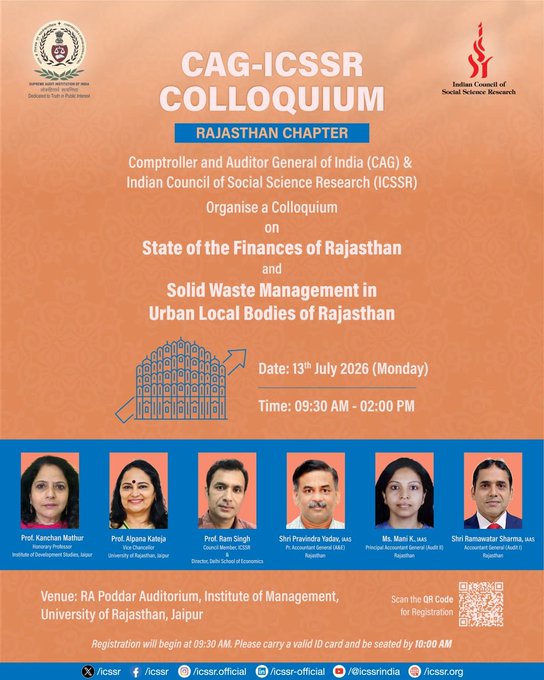
CAG-ICSSR Colloquium on State of the Finances of Rajasthan and Solid Waste Management in Urban Local Bodies of Rajasthan
Venue: RA Poddar Auditorium, Institute of Management, University of Rajasthan, Jaipur
Date: 13 July, 2026
The ICSSR–CAG Academic Interaction Programme & Colloquium on the theme "Using CAG Data for Social Science Research and Strengthening Solid Waste Management Governance" brought together academicians, researchers, students, public administrators, and audit professionals to deliberate on the role of authentic government data in strengthening evidence-based policymaking and sustainable urban governance. The programme underscored the importance of collaboration between the Indian Council of Social Science Research (ICSSR), the Comptroller and Auditor General (CAG), universities, and the research community in promoting rigorous social science research and informed public discourse.
The programme commenced with a welcome address by Shri Ramavatar Sharma, who welcomed the distinguished guests, faculty members, researchers, and students. In his address, Shri Ramavatar Sharma highlighted the growing importance of authentic government data in governance and policymaking, encouraged students to utilise government reports and datasets for research, and explained the significance of CAG reports in understanding public finance and accountability.
Prof. Alpana Kateja emphasized the importance of data as a powerful tool for governance and policy analysis, highlighting the need for data democratization, accessibility, and its correct interpretation. She encouraged students and researchers to utilise data for constitutional, social science, and public policy research. Ms. Mani K. introduced the role of ICSSR in promoting quality social science research and outlined the various fellowships, grants, and research opportunities available to scholars, motivating participants to undertake evidence-based and policy-oriented studies. Shri Ravindra Yadav explained the constitutional role of the CAG in ensuring public financial accountability and introduced key CAG publications, including the Annual Accounts, State Finance Audit Reports, Public Finance Statistics, and Fiscal Health Indicators. He demonstrated how these datasets can be effectively utilised for trend analysis, inter-state comparisons, and public policy research. Prof. Ram Singh emphasized the importance of stronger collaboration between academia and public institutions, encouraging interdisciplinary research using authentic public finance data and highlighting its contribution to transparency, accountability, and sustainable development.
The discussions on public finance and governance focused on public finance as an instrument for public welfare, the distinction between public and private finance, fiscal discipline, sustainable development, revenue and expenditure management, fiscal deficit, debt sustainability, financial accountability, and the importance of evidence-based policymaking. Deliberations on urban governance and municipal finance highlighted that cities contribute nearly 65–70 per cent of India's economic output and emphasized the need for stronger financial resources for Urban Local Bodies, property tax reforms, and improved municipal finance to strengthen urban service delivery. The discussions also examined key urban challenges, including waste management, water quality, air pollution, public health, and urban infrastructure.
A dedicated session on Solid Waste Management (SWM) examined India's evolving waste management framework and audit findings. Discussions emphasized the importance of source segregation, scientific collection, transportation, treatment, recycling, and disposal of waste, along with the need for decentralized composting, biomethanation, Material Recovery Facilities (MRFs), and improved management of e-waste and legacy waste. The programme also featured a detailed discussion on the Proposed Solid Waste Management Rules, 2026, highlighting reforms such as the Polluter Pays Principle, environmental compensation for violations, digital waste tracking through a centralized online portal, mandatory Refuse Derived Fuel (RDF) targets for cement and waste-to-energy industries, stricter landfill regulations, scientific remediation of legacy waste through biomining and bioremediation, formal recognition of Material Recovery Facilities, and special provisions relating to tourism-linked waste management. The discussions further highlighted global best practices, including source segregation, door-to-door segregated collection, composting, biomethanation, Extended Producer Responsibility (EPR), GPS-enabled collection systems, smart bins, deposit-refund mechanisms, and circular economy approaches.
The programme concluded with recommendations to strengthen solid waste management through universal source segregation, expansion of decentralized composting, scientific waste processing, digitization of waste collection systems, enhanced monitoring and accountability, stronger Material Recovery Facilities, increased citizen participation, public awareness initiatives, and promotion of the principles of Reduce, Reuse, and Recycle (3Rs).
The ICSSR–CAG Academic Interaction Programme & Colloquium successfully demonstrated how authentic government data and public audit findings can strengthen social science research, evidence-based policymaking, and accountable governance. The discussions inspired students and researchers to utilise reliable public datasets for impactful research while reinforcing the importance of collaborative engagement between academia and public institutions in advancing sustainable development and good governance.
To receive notifications about the latest announcements, follow us on Twitter, Instagram, Facebook, WhatsApp , and LinkedIn.