

Soft Power in Foreign Policy: China's Strategic Use of Trade, Culture and Diplomacy
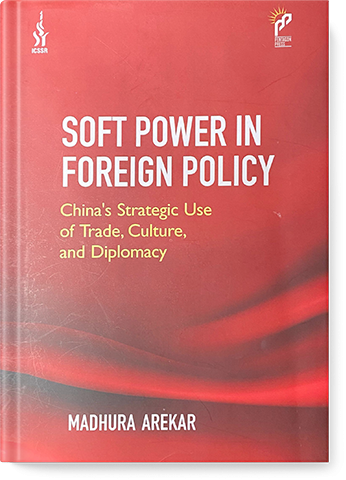
Author : Madhura Arekar
Co-publisher: Pentagon Press
Publication Year : 2025
Price : 995
About the Book
In the context of ever-changing international relations, countries can not only depend on hard power instruments to produce desired effects. Tools of soft power could be used to achieve national interests. China's emergence as the second largest economy in the world is the pivotal moment of 21" century. In 1978, China adopted market reforms. Later, China promoted foreign policy of Peaceful Development and Harmonious World. Lately, it has carried out Belt and Road Initiative. It is evident that, China has realised the importance of soft power and adopting diverse initiatives such as Confucious Institute, Beijing Olympics, Shanghai Expo and many more to create is benign image. Therefore, the study of China's soft power has received tremendous attention from the scholars and practitioners of international relations.
This particular book attempts to understand the Chinese notion of soft power. It advocates that China employs soft power instruments to create a convergence of its own national interest and that of others. Further it explores how China is strategically using trade, investment, culture and language as soft power instruments.
About the Author
Madhura Arekar is Assistant Professor of Political Science at Sir Parashurambhau College (Empowered Autonomous), Pune. She holds a Ph.D from the University of Mumbai on Soft Power in Foreign Policy: A Case of China. With over twelve years of teaching and research experience, her academic interests span International Relations, Foreign Policies and the study of Soft Power. She has contributed chapters to Multilateralism in the Indo-Pacific: Conceptual and Operational Challenges (Routledge, 2022) and China and the Indo-Pacific: Manoeuvres and Manifestations (Palgrave Macmillan, 2023). In addition, she has presented her research at several national and international conferences and delivered lectures on issues in contemporary global politics.
| Contents | |
|---|---|
| 1. | Introduction |
| 2. | Meaning and Instruments of Soft Power |
| 3. | Trade as an Instrument of Soft Power |
| 4. | Investment as an Instrument of Soft Power |
| 5. | Culture and language as an Instruments of Soft Power |
| 6. | Conclusion |
| Bibliography | |