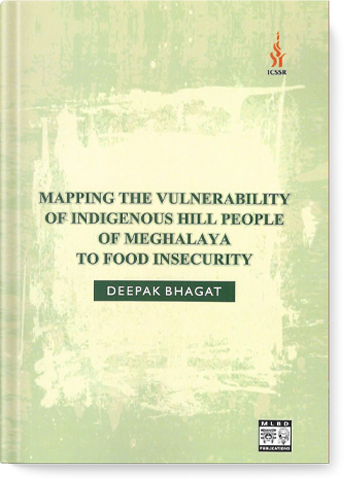
Mapping the Vulnerability of Indigenous Hill People of Meghalaya to Food Insecurity

Author : Deepak Bhagat

Co-publisher: Motilal Banarsidass Publications

Publication Year : 2026

Price : 395

About the Book

This book is an outcome of the Impactful Policy Research in Social Science (IMPRESS) project, "Mapping the Vulnerability of Indigenous Hill People of Meghalaya to Food Insecurity” funded by the Indian Council of Social Science Research (ICSSR), New Delhi. It provides a comprehensive analysis of food insecurity and vulnerability among the indigenous hill tribes of Meghalaya, offering a data-driven foundation for developing effective policies and targeted programmatic activities. Beyond documenting the current landscape of food availability, accessibility, and utilization, the book highlights the vital role of local and ethnic plants in food system of indigenous hill people.

About the Author

Dr. Deepak Bhagat is Professor and Head in the Department of Agribusiness Management and Food Technology, North Eastern Hill University, Tura Campus, Meghalaya. He did his PhD from Gauhati University, Guwahati and MBA (Agribusiness) from Assam Agricultural University, Jorhat. He is deeply involved in various academic and professional bodies. He has seven books and five edited books to his credit. He has more than 50 research papers in national and international refereed journals. He also has more than 46 research papers in edited books. He has successful completed four external funded research projects. He has presented papers in seminars and conferences of national and international level. The field of interest of Dr Bhagat is Agribusiness, Agri-Supply Chain Management, Food Insecurity and Food Sovereignty under Mountain Specificities. He is engaged in teaching and research for over eighteen years. He is also in the editorial board of national and international journals.


Contents
Preface
List of Tables
List of Figures
List of Appendices
Introduction
1.1.Introduction
1.2.Food Security and Vulnerability to Food Insecurity
1.3.Identification of Research Gap
1.4.Statement of the Problem
1.5.Research Questions
1.6.Objectives of the Study
1.7.Significance of Study
1.8.Outline of the Study
Conceptual Framework
2.1.Conceptualizing Food Security
2.2.Conceptualizing Vulnerability to Food Insecurity
2.3.Measuring Food Security
 2.3.1. Aggregate Food Availability
 2.3.2. Household Food Access
 2.3.3. Individual and Household Food Utilization
2.4.Measuring Vulnerability to Food Insecurity
2.5.Conclusion
Review of Literature
3.1.Food (In)security in Hills and Mountains
 3.1.1. Mountain Specificities and Food (In)security
 3.1.2. Mountain Specificities and Food (In)security
3.2.Nature and Causes of Food Insecurity in Hills and Mountains
 3.2.1. Persistent Poverty in Hills and Mountains
 3.2.2. Changing Dietary Habits and Deteriorating Local Food Systems
 3.2.3. Natural Calamities, Climate Change and Depleting Natural Resources
 3.2.4. Hill and Mountain Specificities in Research, Policies and Programmes
3.3.Potential of Hills and Mountains in Ensuring Food Security
 3.3.1. Taping the Benefit of Indigenous and High Value Mountain Crops
 3.3.2. Taping the Benefits of Indigenous Foods and Local Food Systems
 3.3.3. Taping the Benefits of Indigenous Farming and Traditional Knowledge
 3.3.4. Promoting Rural Non-Farm Economic Opportunities
3.4.Food In (Security) in Meghalaya
3.5.Conclusion and Research Gap
Research Methodology
4.1.A Brief Overview of the Study Area
4.2.Sampling
 4.2.1. Defining clusters and constructing the sampling frame
 4.2.2. Choosing clusters for inclusion in the sample
 4.2.3. Choosing households from within selected clusters for inclusion in the sample
4.3.Data Collection
 4.3.1. Measuring Food Security
 4.3.2. Measuring Vulnerability to Food Insecurity
 4.3.3. Evaluation of the Cultural Significance of Local Edible Plant
 4.3.4. Description of Selected Key Indicators for Measuring Food Security and Vulnerability to Food Insecurity
4.4.Data Analysis.
Food and Nutrition (In) Security in Mountain States of India
5.1.Indian Approach towards Sustainable Development Goal 2 (Zero Hunger)
5.2.Sustainable Development Goals 2 (Zero Hunger) and Hill and Mountain States of India
 5.2.1. Performance of Hill and Mountain States on Indicator for SDG 2
 5.2.2. Performance of Hill and Mountain States on SDG 2 (Zero Hunger)
5.3.Food and Nutrition Security in the Mountains States of India
5.4.Food and Nutrition Security in Meghalaya
Results and Discussion
6.1.Socio-Economic Conditions of the Indigenous Hill Households of Meghalaya
 6.1.1. Demographics of Sample Indigenous Hill Households
 6.1.2. Literacy/Education of Sample Indigenous Hill Households
 6.1.3. Physical and Financial Capital of Sample Indigenous Households
6.2.Cropping Practices and Pattern of the Indigenous Hill People of Meghalaya
6.3.Current Household Food Security Status of the Indigenous Hill People of Meghalaya
 6.3.1. Aggregate Food Availability in Meghalaya
 6.3.2. Household Food Access of Indigenous Hill People of Meghalaya
 6.3.3. Individual and Household Food Utilization
6.4.Vulnerability of the Indigenous Hill People of Meghalaya to Food Insecurity
 6.4.1. Indicators of Vulnerability of Indigenous Hill Households to Food Insecurity
 6.4.2. Factors Affecting Vulnerability of Indigenous Hill Households of Meghalaya to Food Insecurity
6.5.Local and Ethnic Food used by Indigenous Hill People of Meghalaya
6.6.Food Security Schemes in Addressing Food Security Issue of the Indigenous Hill Households of Meghalaya
Summary and Policy Recommendations
7.1.Introduction
7.2.Research Methodology
7.3.Summary of Findings
 7.3.1. Food and Nutrition (In) Security in Mountain States of India
 7.3.2. Socio-Economic Conditions of the Indigenous Hill Households of Meghalaya
 7.3.3. Cropping Pattern of the Indigenous Hill People of Meghalaya
 7.3.4. Current Household Food Security Status of the Indigenous Hill People of Meghalaya
 7.3.5. Vulnerability of the Indigenous Hill People of Meghalaya to Food Insecurity
 7.3.6. Local and Ethnic Food used by Indigenous Hill People of Meghalaya
 7.3.7. Food Security Schemes in Addressing Food Security Issue of Indigenous Hill People 
 7.3.8. Conclusion
7.4.Policy Recommendations for ImprovingFood Security of Indigenous Hill People of Meghalaya
7.5.Research Limitations and Suggestions for Future Research
 7.5.1. Research Limitations
 7.5.2. Suggestions for Future Research
References
Appendices
Appendix I
Appendix II
Appendix III